


Potential Harms of Prostate Cancer Screening
test
Prostate cancer screening can lead to potential harms:
1. PSA testing may have false positive results (1 in 8 men) which can lead to unnecessary investigations and procedures.
2. PSA testing can lead to overdiagnosis (20-40%). It often does not improve the quality of life or reduce mortality.
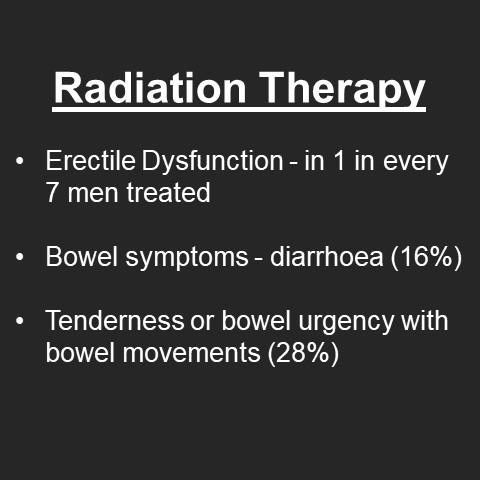
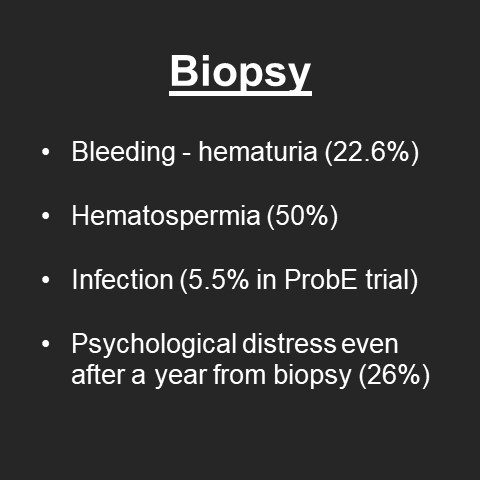
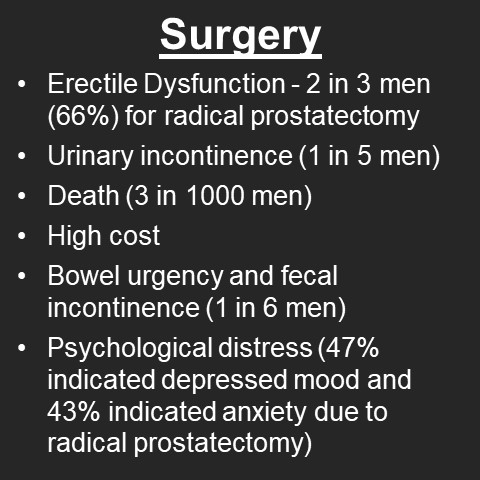
 Click/hover over the bubbles to read more about the potential harms from the procedures related to prostate cancer screening (radiation therapy, biopsy and surgery).




References:
- Fowler FJ Jr, Barry MJ, Walker-Corkery B, et al. The impact of a suspicious prostate biopsy on patients' psychological, socio-behavioral, and medical care outcomes. J Gen Intern Med. 2006;21(7):715-721. doi:10.1111/j.1525-1497.2006.00464.x
- Johansson E, Steineck G, Holmberg L, et al. Long-term quality-of-life outcomes after radical prostatectomy or watchful waiting: the Scandinavian Prostate Cancer Group-4 randomised trial. Lancet Oncol. 2011;12(9):891-899. doi:10.1016/S1470-2045(11)70162-0
- Raaijmakers R, Kirkels WJ, Roobol MJ, Wildhagen MF, Schrder FH. Complication rates and risk factors of 5802 transrectal ultrasound-guided sextant biopsies of the prostate within a population-based screening program. Urology. 2002;60(5):826-830. doi:10.1016/s0090-4295(02)01958-1
- Roehrborn CG, Black LK. The economic burden of prostate cancer. BJU Int. 2011;108(6):806-813. doi:10.1111/j.1464-410X.2011.10365.x
- Talcott JA, Rieker P, Clark JA, et al. Patient-reported symptoms after primary therapy for early prostate cancer: results of a prospective cohort study. J Clin Oncol. 1998;16(1):275-283. doi:10.1200/JCO.1998.16.1.275
- U.S. Preventive Services Task Force., & United States. (2018). U.S. Preventive Services Task Force (USPSTF): Screening for Prostate Cancer. Accessed 10 Nov 2021. Rockville, MD: U.S. Dept. of Health & Human Services, Agency for Healthcare Research and Quality.
- Wilson LS, Tesoro R, Elkin EP, et al. Cumulative cost pattern comparison of prostate cancer treatments [published correction appears in Cancer. 2007 May 15;109(10):2155]. Cancer. 2007;109(3):518-527. doi:10.1002/cncr.22433