


Introduction to shared decision making
"Shared decision making occurs when a patient and a doctor discuss, negotiate and finally agree on a decision."
This usually occurs when there is a clinical equipoise, or the decision is preference sensitive.
In the case of prostate cancer screening, the evidence on whether or not to screen is conflicting and the patient's preference should be considered.
Being a primary care doctor, it is a privilege of the profession to assist in the complex decision making process for prostate cancer.
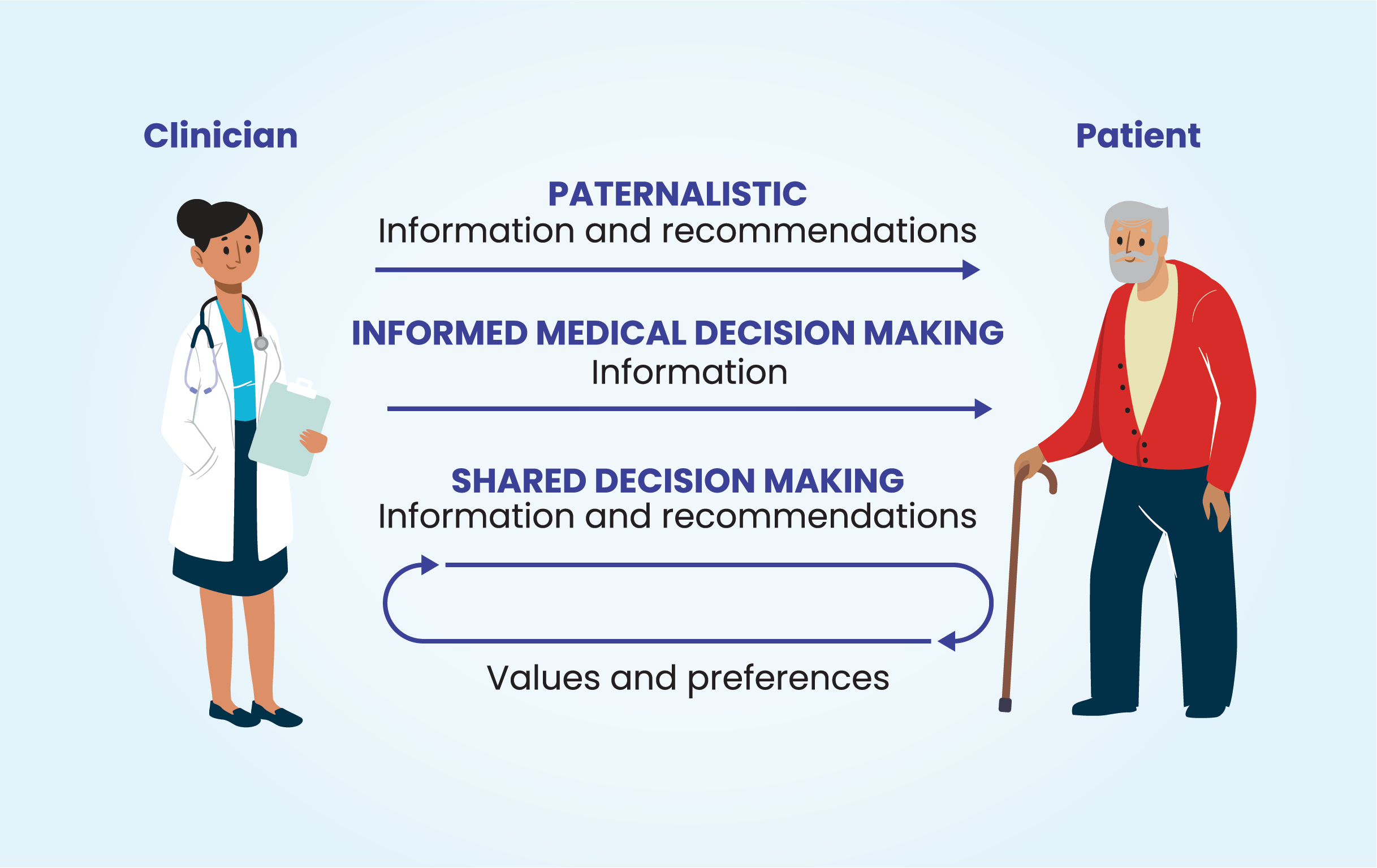
Shared decision making is in between paternalistic decision making and informed decision making in the decision making spectrum. See the diagram below to learn more.

In paternalistic decision making, the doctor provides information and recommendations to patients.
In informed decision making, the doctor only provides information to the patients and the patients have to make their own decision.
In shared decision making, the doctors provide information and recommendations after considering patients' values and preferences.
References:
- Schrager S, Phillips G, Burnside E. A simple approach to shared decision making in cancer screeening. Family Practice Management, 2017;24(3):5-10.
- Charles C, Gafni A, Whelan T. Decision-making in the physician-patient encounter: revisiting the shared treatment decision-making model. Soc Sci Med. 1999;49(5):651-661. doi:10.1016/s0277-9536(99)00145-8